

AI adoption is the process by which organisations make AI a lasting part of how they work. Not as an experiment, but as part of the culture. TwoFeetUp supports that change with proven frameworks for roles, governance and change management.
AI adoption starts with people, not technology
The technology works. The AI is smart enough. The tools exist. The real challenge is change management.
AI adoption answers the "why" and the "who". Our AI approach sets the strategy. With the Second Brain, we build the solution and provide the infrastructure. Workshops help your team learn.
Why does AI adoption fail without structure?
Most companies that are "doing something with AI" find themselves in the same situation: there is enthusiasm, there are scattered initiatives, but there is no coherent policy. Everyone simply does what they think is right.
"At first it all seems like fun, but three months later you suddenly have hundreds of custom GPTs floating around and everyone is doing it their own way. You're accelerating the chaos."
What happens if you do nothing
Which roles does your organisation need?
Not new jobs, but hats people wear alongside their existing role. In small companies, one person can hold two of these roles.
How the three roles work together
What is shadow AI and why is it dangerous?
Shadow AI is the AI version of shadow IT: employees using AI tools on their own initiative, without the organisation knowing about it, having a policy on it, or having any control over it.
Data leaks
Company documents in free ChatGPT accounts without a data processing agreement.
Inconsistency
Every employee gives a different answer to the same customer question.
No knowledge retention
Insights and prompts disappear into individual chat histories.
Compliance breaches
Personal data processed in tools that do not comply with the GDPR.
Sprawl
Hundreds of unmanaged custom GPTs, and nobody knows who made what.
Fragmented stack
Everyone on a different tool, no integration, no overview.
Structure instead of bans
- Choose an enterprise platform that complies with the GDPR and protects your data.
- Set guidelines: what is allowed, what is not, and where the boundaries are.
- Centralise knowledge in a Second Brain so everyone works from the same source, even if you already have Microsoft 365 Copilot.
- Appoint owners (product owners) who manage tools and agents.
- Monitor and evaluate every month which tools are being used and what they deliver.
How do you break through resistance to AI?
The biggest challenge in implementing AI is not technical. The product works. The AI is smart enough. The real challenge is change management.
From old to new
How do you decide where to start with AI?
The standard prioritisation matrix has two axes: impact and effort. TwoFeetUp added a third: skill. Because an automation with high impact and low effort that needs weeks of training is not the best first step.
Impact
How much value does it deliver? Time saved, better quality or more revenue.
Effort
How much time and money does it take to implement? Anything from an hour of set-up to six months of building.
Skill
How much training does the team need? Some solutions need none at all, others take weeks.
High impact, low effort, low skill
Example: an automatic meeting note-taker that logs to your CRM. Your people barely notice it. No training needed, instant results.
Starting with the sweet spot frees up time to implement more AI. AI becomes its own flywheel.
Why a hackathon is the best first step
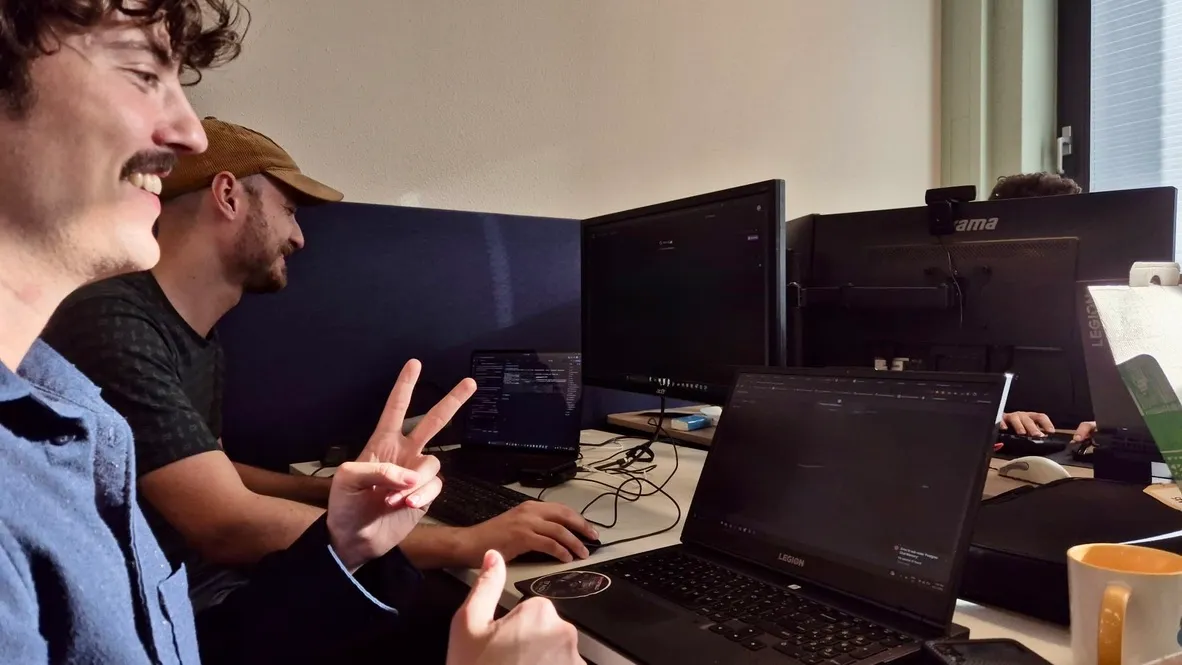
It breaks through resistance, sparks enthusiasm and lets people experience what AI can do. Not by talking about it, but by doing it themselves. In a few hours your team builds a complete app or prototype.

How do you get from 0 to 80%?
Sweet spot automations
Start with automations that require no specialist skills. A meeting note-taker, email summaries, automatic CRM logging. Your people barely notice them.
Reinvest the time you free up
Put the time you save into learning AI. Short, hands-on sessions that people can apply to their own work straight away.
The 80% rule
After a month of working with AI consistently, everyone is at 80%. Getting from 0 to 80% is relatively easy. The last 20% is specialisation.
Formalise the roles
Formally appoint the strategy lead, product owners and champions. Pin down responsibilities, set up governance.
Monthly hackathon
Keep it playful. A hackathon every month to discover new use cases and keep the enthusiasm alive.
Scale-ups vs established companies
Scale-ups
- Faster decisions, fewer layers
- Often already digitally mature
- A culture of experimenting is already there
- Risk: too fast, too chaotic
Established companies
- More bureaucracy, longer lead times
- Bigger impact when adoption succeeds
- Champions are essential for buy-in
- Risk: too slow, initiatives fizzle out
AI adoption programmes at TwoFeetUp are guided by Wouter van den Bijgaart (author of the frameworks, lecturer at Beeckestijn Business School, speaker for Businesswise, a Dutch business media platform). TwoFeetUp developed both the three-role model and the Impact-Effort-Skill Matrix. Both have proved their value in dozens of organisations.
Frequently asked questions about AI adoption
Not what you are looking for?
Ready to bring your organisation on board with AI?
Book a 20-minute discovery call. No reports, no PowerPoints. Just a conversation about where AI could deliver the most value.