

second-brain · ai-adoption · ai-hub
Your Second Brain can be your AI adoption coach too
How a Second Brain supports AI adoption in everyday work with context, feedback and reusable skills.
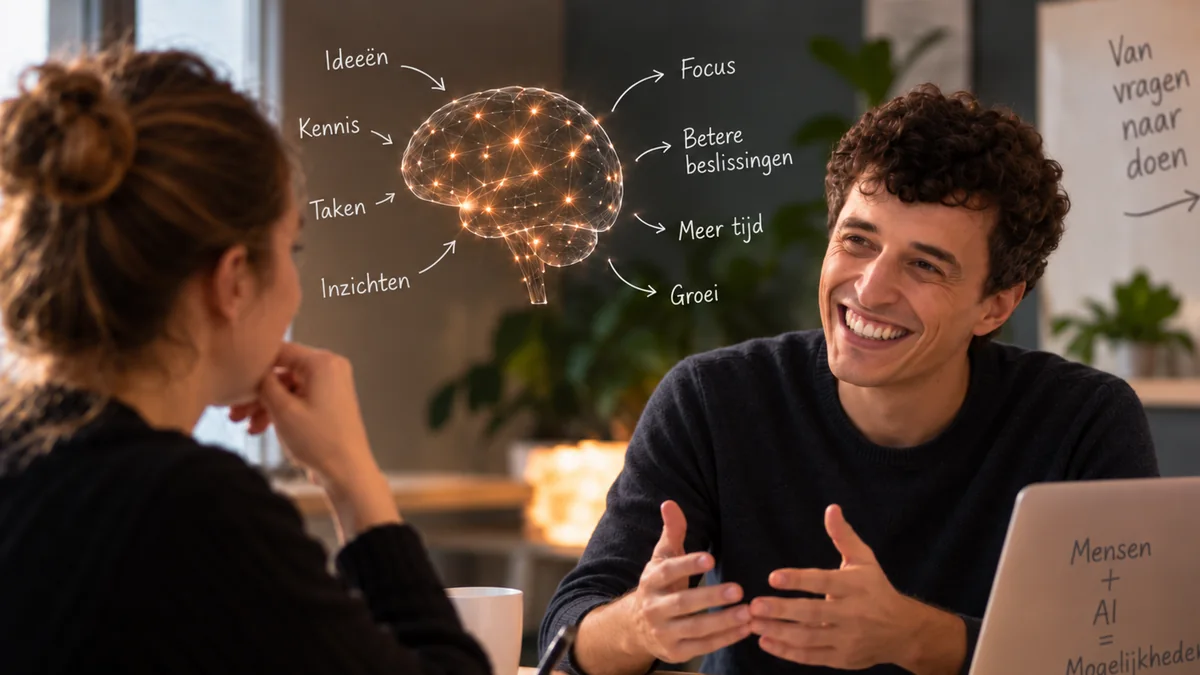
Most AI training follows a familiar pattern. On the day itself, everyone is enthusiastic. People write strong prompts, see new possibilities and the first use cases emerge.
Then Monday arrives.
The inbox is full, a client is waiting and the old way of working is quicker than trying to remember that great prompt from last week. A month later, a small group uses AI every day, a larger group uses it now and then, and some have stopped altogether.
The problem isn't a lack of willingness to learn. Training is too far removed from people's daily work.
Build AI adoption into everyday tasks
Real AI adoption happens when people can put a new approach to work as soon as they need it, not when they recall what they heard in a workshop.
That is exactly where a Second Brain can be more than a source of company knowledge. It can also become the learning layer of an adoption programme.
In a configured AI Hub, relevant context can be added before a question reaches the model: the employee's role, internal agreements, current procedures, examples and previously captured skills. The employee needn't know the perfect prompt up front: the AI Hub helps turn an ordinary question into a more useful prompt.
That lowers the barrier to using AI well, right in the middle of everyday work.
From prompt to learning loop
Say an account manager asks: “Write a proposal for this client.”
Without the organisation's context, AI produces a generic proposal. With a Second Brain, the same question can be enriched with the offerings you actually provide, the agreed tone of voice, relevant client information and the steps your team follows when preparing a proposal.
The account manager remains responsible for the result. But the first draft no longer starts from zero.
Then something more important happens. The employee spots that one part is wrong and corrects it. The content owner can then review that feedback. Is this a one-off exception, or an improvement that applies to everyone? Only in the second case is it captured as knowledge, an instruction or a skill.
- An employee asks a questionAbout a real task from their working day, not a practice prompt.
- The Second Brain adds contextThe Second Brain adds relevant context, agreements and ways of working to the question.
- AI helps get it doneThe response better reflects the organisation’s context and the employee’s role.
- A person gives feedbackThe employee corrects what is wrong and points out what could be better.
- The team captures itUseful feedback is deliberately saved as knowledge, an instruction or a skill.
- The next task gets a head startThe improved approach is ready for the whole team to reuse.
Capturing an improvement closes the loop. Saving a chat does not.
That is how a flywheel starts. Not because AI learns from every conversation by itself, but because the organisation has a deliberate route from use to feedback, and from feedback to a better way of working.
Personal support, without a coach next to every desk
Employees don't all start at the same level. One is already building agents, another is still unsure what can and cannot go into a chat. Generic training treats them the same, even though their next step is different.
A Second Brain can give each employee support that fits their role and task. It needn't judge people by the number of prompts they send.
- If a question is very broad, the AI asks about the goal, the audience and the desired end result.
- If context is missing, it suggests the relevant procedure, client agreement or example skill.
- If the task comes up often, the employee gets a suggestion to capture the approach as a repeatable skill.
- If an answer departs from policy, the AI shows the applicable source and asks for a human check.
- If feedback could be useful to others, the correction goes to the right content owner for review.
That is coaching in the flow of work: small, relevant and right on time.
What you can actually measure
Adoption is often measured in logins, licences or the number of prompts sent. That mainly tells you whether a tool was opened. Not whether the work is getting better.
A mature adoption programme looks instead at signals such as:
- which recurring tasks are carried out with a captured skill;
- where employees still keep making the same correction;
- which sources are missing or contradict each other;
- how many teams reuse the same good way of working;
- which tasks consistently need human oversight;
- and whether the quality of a process is demonstrably becoming more consistent.
That shifts the question from “are people using AI?” to “is our organisation getting better at working with AI?”
The AI Hub and external tools are not the same
There is an important nuance here. Within the AI Hub, the Second Brain can add relevant context to every conversation by default.
If someone uses ChatGPT, Claude or another external environment, the Second Brain does not automatically intercept every prompt. In an external tool, company context is available through a connection such as MCP, but the user or configured agent must explicitly request it.
That difference matters for adoption. In the Hub, the intended way of working can be the default. In external tools, you need to pay extra attention to instructions, setup and behaviour. Both routes can work, but they don't call for quite the same guidance.
You can read more about those two routes on our Second Brain page.
No automatic memory, but organised learning
Feeding all feedback straight back in sounds appealing. Usually, though, you don't want that. People make mistakes, situations differ and a correction for one client may be exactly wrong for another.
That is why organised learning needs three roles:
- The employee flags where the answer or process could be better.
- The content owner decides whether the improvement holds in general.
- The adoption team or product owner keeps track of where the knowledge ends up and who may use it.
AI can help recognise feedback, summarise it and route it to the right person. Any decision to change how everyone works remains deliberate and traceable.
That isn't a brake on adoption. It is what stops a mistake from spreading as fast as a good improvement.
From training programme to everyday system
Workshops, champions and coaching remain valuable. They give people a shared vocabulary, confidence and direction. But without a place where people can apply those lessons in their daily work, adoption depends on the memory and enthusiasm of individual employees.
A Second Brain turns AI adoption into an everyday system:
- employees get context at the moment they are working;
- good ways of working become shareable rather than personal;
- feedback finds an owner;
- improvements are captured deliberately;
- and the next employee doesn't have to start with an empty chat.
Want to know which knowledge and ways of working are still getting lost between people, documents and chats in your organisation? Then start with the knowledge leak scan (in Dutch). It shows where your biggest knowledge leaks are and where an adoption programme can best begin.