

ai-adoption · ai-maturity · ai-agents
Are you using AI, or just an expensive version of Google?
Asking ChatGPT the odd question is not AI adoption. Here is how to grow from occasional chatting to AI that genuinely works with your organisation.
“We’re already doing loads with AI.”
We hear that a lot. Dig a little deeper and it usually comes down to this: someone opens ChatGPT, asks a one-off question and closes the tab again. The next day, the same ritual starts over.
That isn't worthless. It just isn't real AI adoption yet. It is a faster search engine with a text box.
An empty chat is a new colleague every time
Imagine onboarding a new colleague every single morning. You explain who the client is, what your tone of voice is, which agreements apply and what good work looks like. At the end of the day, you send that colleague home. The next morning someone else turns up, with no memory of yesterday.
That is how many organisations use AI.
The AI can do a lot, but it lacks context. It doesn't know which documents are authoritative, how you make decisions or which exception applies to that one client. So people write ever longer prompts, paste the same background information into the chat yet again and keep checking for the same mistakes.
The technology is smart. The workflow resets every time.
AI use has levels
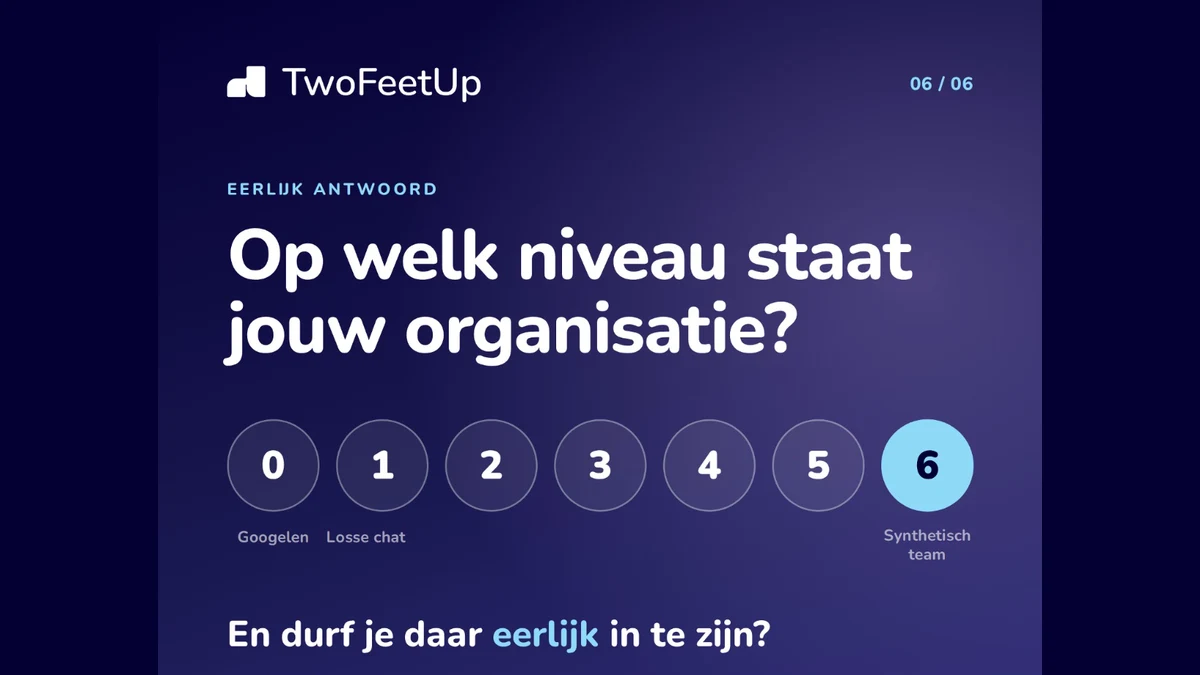
We use a scale from 0 to 6. It is a starting point for an honest conversation about how AI fits into the work, not a score.
0. Googling. You find the information and work out how to apply it yourself. AI is not involved yet.
1. One-off chat. You ask a question without any fixed context. The next chat starts over.
2. AI profile. The AI knows your role, preferences and basic instructions. The organisation's context is still missing.
3. Second Brain. The AI is given relevant company knowledge and sources. The way of working isn't always repeatable yet.
4. Memory and skills. Corrections and approaches that work are deliberately captured. The AI still does little on its own.
5. Agent with tools. An agent can take steps in systems, within clear limits. Collaboration between several specialists is still limited.
6. Synthetic team. Several specialised agents work together with people and systems. Governance, oversight and a sharp division of roles remain essential.
Most organisations that say they are “already doing loads with AI” are at level 1 or 2. The real shift starts at level 3: the AI gets not just a question, but the organisation's context as well.
Train your AI like a new colleague
Take inbox triage. You could ask every morning: “Which emails are important?” Then you still have to explain which clients take priority, what counts as an escalation and which messages you never want answered automatically.
Or you can work out the process with the AI.
The first time, the AI watches as you work through the inbox. You correct it: this client is strategic, that request can go to support, and when in doubt this type of message always comes to me. Then you capture the approach in a skill file: sources, steps, decision rules and exceptions.
The next day the AI uses not just your new instruction, but also the agreed way of working. You check the outcome and sharpen the skill. Over time, most of the predictable triage can run on its own, while exceptions deliberately stay with a person.
That percentage isn't a magic target. What matters is the pattern: show, correct, capture and reuse.
A correction is not a memory
This is an important AI pitfall. A model doesn't automatically “learn” for the whole organisation just because you tell it in a chat that an answer is wrong. Often it only remembers that correction within that conversation, and sometimes not even reliably.
Learning only happens when you anchor a good correction somewhere outside the one-off chat. For example as:
- an instruction in the AI profile;
- verified knowledge in a Second Brain;
- a repeatable skill with steps and quality criteria;
- or a human agreement about what AI may and may not do on its own.
Without that step, you get more chats. With it, you build organisational capability.
Stop living as a biological robot
Much knowledge work consists of steps someone worked out once, then repeats hundreds of times in the same way. Gathering information. Running a standard check. Filing an email in the right category. Going through five systems before a decision can be made.
That is precisely the work that turns smart people into biological robots.
Good AI adoption doesn't take people out of the process. It lets people focus on the work that calls for judgement, creativity, empathy and responsibility. AI takes over the predictable groundwork. The employee sets the direction and keeps an eye on the exceptions.
That is where the gain lies: not automating as much as possible, but getting time back for work that people are uniquely good at.
What level is your organisation at?
The question is not which AI tools you already pay for. Ask instead:
- How often does a task still start with an empty chat?
- What context does AI get by default?
- Where are good corrections and prompts captured?
- Which recurring ways of working already exist as a skill?
- And for which tasks can AI act on its own within clear limits?
You don't need to reach level 6 tomorrow. But if you look honestly at where you stand, you can choose the next step.
Can you answer those questions honestly?